
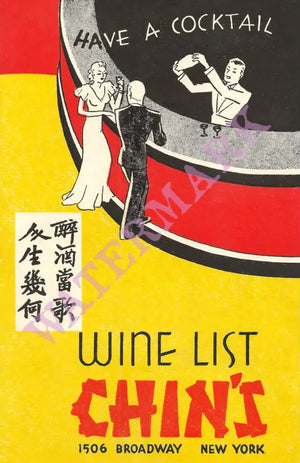


Chin's Wine List, New York, 1937
Free Shipping In The US
The Chinese characters on the cover of Chin’s Wine List is a rhyming couplet slightly tweaked from the original: the first character has been changed from a famous
poem by Cao Cao, a general and poet in the Eastern Han dynasty. The tweaked couplet says: ‘When drunk and singing, who cares about life?’ The original says : ‘When there’s fine wine and singing, who cares about (the shortness of) life?’ Classical Chinese poetry is concise and highly elliptical, quite unlike modern Mandarin. Most secondary students who have studied in a Chinese school would be familiar with the poem.
The entrance to this restaurant was located in Times Square just below the famous 30ft x 100ft Camel cigarette sign featuring actual smoke that blew out into the street for 25 years until 1965.
The owner was Chin Lee (1870-1965), who immigrated from Taishan, Guangdong, and opened his first restaurant in Rhode Island in 1913. He opened a second Chin Lee in New York City in 1924, seating 800, and featuring a live band and floor show.
Mr Lee then opened the even larger Chin’s on Broadway and 44th and it became a destination for out-of-towners and theatre-goers, open from noon till 2am. Postcards of the interior show lavishly decorated rooms with Chinese lanterns hanging from a blue ceiling, a huge dance floor in the middle and a stage with a pagoda.
‘Chin’s is a Broadway institution and not to know the delights of its palpitating dance music is to leave the city without having tasted the delights of the metropolis,’ one reviewer wrote.
The food offering was Chinese or American, and there was a minimum table charge of $1.50 for dancing and watching the nightly revue. Wildly successful, Mr Lee is estimated to have produced revenue of $1m a year between the two restaurants– the equivalent of about $20m today.
We estimate Chin’s closed in the late 60s or early 70s.
NOTE: Mr Lee’s daughter was the Chinese American civil rights and labor activist Grace Lee Boggs (1915-2015), best known for her role in the American Marxist movement and the Black Power movement of the 1960s. With her husband James Boggs, a labor leader and writer, she played a pivotal role in the workers’ and civil rights movement of her adopted home city of Detroit.
Thanks to the American Chinese Food Show on YouTube for some of this information.
The menu was drawn by Henri Lamothe, a famous entertainer and illustrator of the period. Here is a Sports Illustrated article on him from 1975: Big Fish In A Small Pond
Gallery quality Giclée print on natural white, matte, 100% cotton rag, acid and lignin free archival paper using Epson archival inks. Custom printed with border for matting and framing.
Printed in USA.
Each product is accompanied by a copy of the interior menu where available.